

6th Lisbon Conference
A DIVIDED WORLD
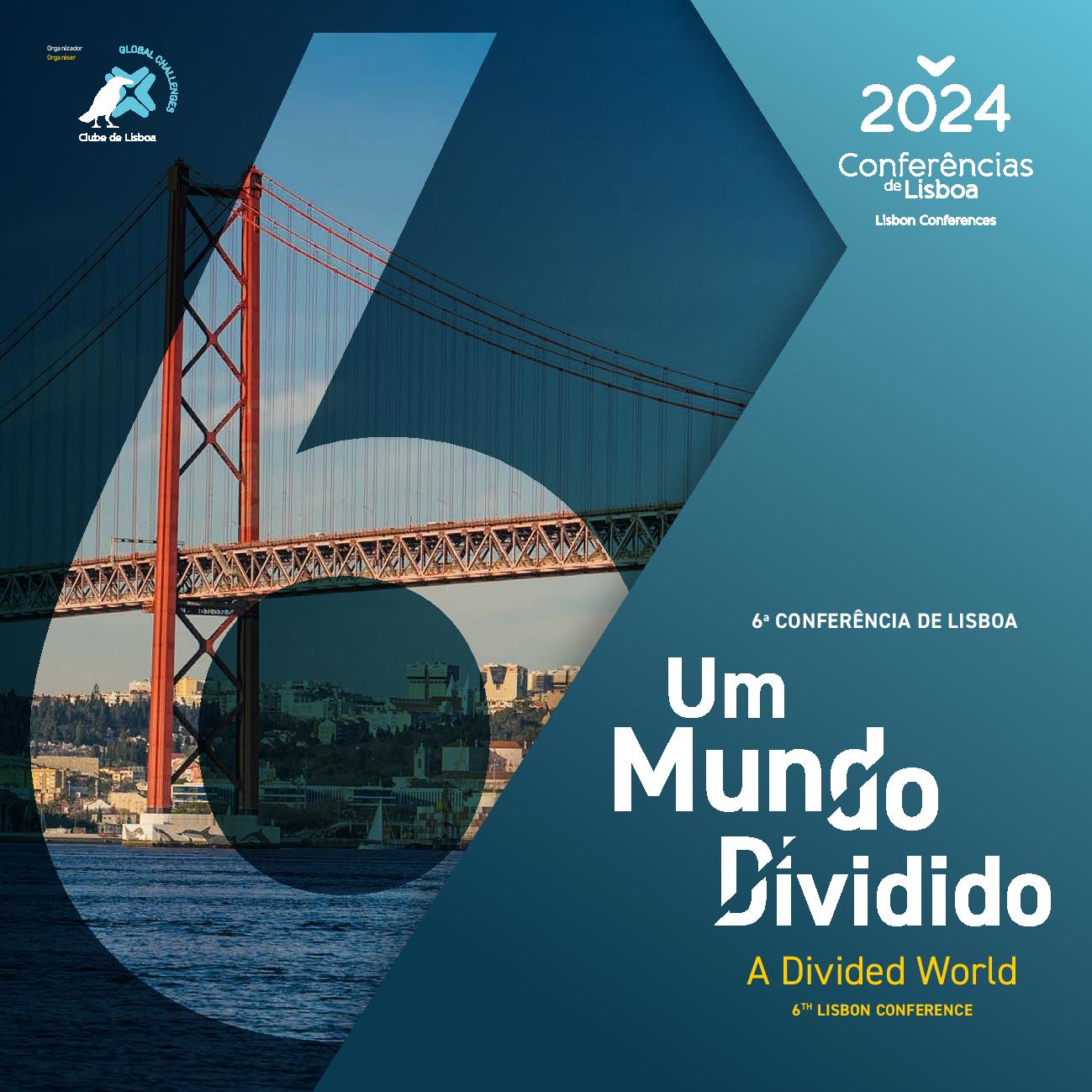
The 6th Lisbon Conference took place on 10 and 11 October 2024 at the Calouste Gulbenkian Foundation. Over two days, 30 national and international speakers discussed the prospects and challenges of our Divided World. The content of this publication is a summary of the speeches and debates that took place, which addressed key issues in the international arena, such as the various dimensions of war and global geopolitics, the major challenges of critical minerals and energy transition, the evolution of nationalism and globalisation processes, technological innovation, the future of employment and inequalities. The Conference not only reflected on existing challenges, but also analysed future prospects and possible responses to current trends.
FULL PUBLICATION
OPENING
Guilherme de Oliveira Martins, Executive Director of the Calouste Gulbenkian Foundation, Francisco Seixas da Costa, President of Clube de Lisboa, and Marcelo Rebelo de Sousa, President of the Portuguese Republic, warned of the international scenario of evident competition for influence, power and resources among powers, as well as questioning multilateralism and the role of international regulatory institutions. The current division in the world is manifested in warmongering rhetoric and the use of military force (including the possibility of nuclear proliferation, in a world that had committed to denuclearisation), in discomfort with established rules and the relativisation of the role of the United Nations, in the breakdown of previously shared values and principles, and in impunity and disregard for international humanitarian law.
PANEL 1: WAR AS AN EXTENSION OF GEOPOLITICS
The pursuit of war today is very different due to digitalisation and media coverage, marked by the progressive absence of borders in terms of information flows, economic exchanges, outer space and cyberspace, finance and markets, among other aspects. The political dimension has not resorted to international cooperation with as much emphasis and effectiveness as before, preferring other ways to achieve its objectives. There has been a transition from markedly ideological divisions to a phase of political and economic pragmatism, in which international actors position themselves to control power and obtain economic and other advantages. In addition, there is a crisis in the construction and maintenance of peace. Not only are there more conflicts, but they are also more prolonged, generating widespread humanitarian crises.
PANEL 2: THE GEOPOLITICS OF CRITICAL MINERALS AND ENERGY TRANSITION
Only now are we waking up to the human, social and even environmental costs that the energy transition entails. Many of the products we use on a daily basis, particularly technological products such as mobile phones and computers, involve the extraction and processing of strategic raw materials, including so-called ‘rare earths’, and we are still very unaware of the related geopolitical factors and the global dispute over control of this type of resource. China has managed to make itself indispensable in global value and supply chains for critical materials, which has implications for the economic dependence and security of several countries, particularly in the Asia-Pacific region. Europe does not yet have a clear industrial strategy that would enable it to invest consistently, and on the necessary scale, in innovation and technologies where it can still take a leading position, having missed opportunities in several fields.
TALK 1: JOURNALISM IN TIMES OF WAR
During this conversation, perspectives and experiences in conflict zones were shared, addressing the ethical, logistical and emotional challenges of war journalism. The discussion was based on accumulated experience in scenarios as diverse as the Balkans, Syria, the Middle East, Mozambique and Ukraine, focusing on the difficulties of accessing unbiased and accurate information in contexts marked by propaganda, misinformation and limitations imposed by the parties involved in the conflicts.
PANEL 3: NATIONALISMS, IDENTITIES AND GLOBALISATION
Nationalism, being a social and political construct, has always been linked to wars on every continent, including Europe. The relationship between nationalism, identity and geopolitics is complex, and takes on different forms depending on historical and geographical contexts, as the histories of Africa and Latin America clearly demonstrate. Immigration is one of the elements that has been used as a weapon by populism and some forms of nationalism. There are many myths and misinformation about this issue, which prevail even when the facts contradict them. In fact, identities are formed very easily and relatively quickly, and also change over time, which means that they are not as deeply rooted and rigid as some would have us believe. Identities can be used positively and constitute a force for change.
PANEL 4: TECHNOLOGICAL INNOVATION, FUTURE OF EMPLOYMENT, INEQUALITIES
The reshaping of global economic power, with the centre shifting to Asia Pacific, has influenced trends in income inequality, particularly over the last 15 years. Western countries are no longer alone in the top 20% of global income distribution, and the stagnation of middle-class incomes in the West has been a source of social discontent and rising populism.
The potential of AI to transform societies is enormous. It seems inevitable that sectors of the population will be ‘left behind’, which means increasing inequalities, particularly economic inequalities (since income will be an important factor in accessing AI technologies in health, education, public services, etc.) and also generational inequalities. We must ask ourselves what we want AI for and how we can use it in the most appropriate way to generate widespread benefits for societies. In the absence of global regulatory rules in this area, the models chosen are, for example, different in the US and Europe.
TALK 2: OPERA AS A STAGE OF CRISES AND POWER GAMES
This session explored opera as a reflection of the social, political and emotional conflicts that mark human history. Using historical examples, musical analysis and live performances of arias by composers such as Monteverdi, Mozart, Verdi, Puccini and Handel, the conversation demonstrated how this art form translates the tensions and aspirations of each era into its narratives and harmonies.
CLOSING
Carlos Moedas, Mayor of Lisbon, acknowledged that there are reasons to be more pessimistic when looking at the world, including ongoing wars, growing global divisions and polarisation of societies, and threats to democracy and the fundamental values of freedom of expression, religious freedom, or simply the freedom to think differently, which are part of European identity. In order to be a global political player, Europe needs to look again at its industrialisation, invest in a single energy market and focus on its security. The technological challenge, with AI and quantum computing, has great potential and represents a unique opportunity, especially for young people. Debating ideas and thinking about our future is more important than ever, and the Lisbon Conferences are a space of great relevance for our city and fundamental for envisaging responses to current challenges.